Showing posts with label Heritage. Show all posts

Friday, July 24, 2009

Linguistic Heritage of India

The cultural heritage of India has a number of aspects to it and linguistic heritage is probably the one, which is most fascinating of all. Linguistic heritage of India is where one can trace the history of different languages spoken in India.


Heritage

India have evolved over a period of time of Indian history. Most of the languages spoken in India in one way or the other belong to two main families of languages, which are the Dravidian and Aryan. Both the Dravidian and Aryan languages have different scripts. There are other languages that belong to the Sino-Tibetan-Mongoloid family. These languages are mostly spoken in the east of India.

Most of the South Indian languages that are spoken today belong to the Dravidian family, while in the northern side of India, the language belongs to the Aryan family. But it is interesting to note here how different invaders during different periods in Indian history affected and enriched the Indian languages.

After the independence of India, policy makers decided to make Hindi as the official language of India, however they declared that English could also be used for official purposes.

The reason behind choosing Hindi as the official language was that it was the most commonly spoken language and its association with the freedom movement of India.

Some of the popular languages spoken in different parts of India include Hindi, English, Tamil, Bengali, Assamese, Malayalam, Gujarati, Punjabi and Urdu. Come on a heritage tour of India and discover the linguistic heritage of India with Heritage in India.
Reblog this post [with Zemanta]

Tuesday, July 21, 2009

Rich Indian cultural heritage of art and architecture

India is endowed with a rich cultural legacy of art and architecture. The numerous beautiful temples and other monuments bear testimony to the rich Indian cultural heritage of art and architecture.


heritage


The Ajanta and Ellora caves in Maharashtra, the Khajuraho temples in Madhya Pradesh, Konark Temple in Puri, Shore Temple at Mahabalipuram in Tamil Nadu and the Taj Mahal in Agra are some of the beautiful monuments that reflect the rich architectural heritage of India. Indian Handicraft is another of form of art that has made a mark among tourists in India.

Indian art and craft has a number of different aspects to it. The art and crafts of India includes painting, sculptures and handicrafts. Indian paintings can be divided into two main categories as the murals and miniatures.

Some of the popular painting forms include the Tanjore Painting of Tamil Nadu, Madhubani Painting of Bihar, Kalamkari Painting of Andhra Pradesh and Pithoro Painting of Gujarat.

The sculptures in various places in India reflect the talent and creativity of Indian artisans. The rock cut art of sculpting was believed to be perfected by the Buddhists and followed by Hindu rulers. The sculptures that we see in many temples and other historic places are made of granite and terracotta.

Handicraft is another feature of the rich Indian art. Some of the handicrafts items that are popular in India are carpets, marble table tops, hand made leather items and hand block printed items, blue pottery, semi-precious stones and Kundan jewellery.

Friday, July 17, 2009

Musical Heritage In India

"Music knows no boundaries" so says a popular proverb and perhaps no country symbolizes this fact better than India does. Musical Heritage In India India is not only the land where people of different faiths and religions live in harmony but it is also the land where diverse musical notes and strings produce riveting symphony.

Musical Heritage In India


Musical heritage tour of India is a unique kind of experience that takes one beyond the obvious. Musical heritage of India touches the inner core of a tourists' heart and takes them to a higher plane.

Be it a child birth, wedding, or death, music is an important part of the Indian way of life. So much so, the musicians here have different ragas for different times of the day.


Musical Heritage In India

One could even listen to raga Megh Malhar especially sung to please the Rain Gods and raga Deepak to light the lamps. The kind of music one gets to listen to in India varies from classical, semi-classical, folk and film music. There are two main forms of music prevalent in India, North Indian Hindustani music and South Indian Carnatic music.

Every year a number of music festivals take place in different corners of India. Most of the times, the venues for these festivals are some important heritage monument, such as the Taj Mahal, Konark sun Temple, Humayun Tomb etc.

Some of the music festivals that take place every year include Sangeet Natak Akademi's festival, New Delhi, Tansen Festival, Gwalior (December), Sur-Sringar Festival, Bombay (November), Tyagaraja Festival, Tiruvayyaru, near Tanjavur (January) and Shanmukhananda Music, Dance and Drama Festival, Bombay (December). Coincide your tour to India with some of these festivals and enjoy the musical heritage of India with Heritage in India.

Monday, June 8, 2009

The language of India

India is a multilingual country. It has been said that India is a living Tower of Babel! There are fifteen national languages recognized by the Indian constitution and these are spoken in over 1600 dialects. Add to this a population of over 900 million today, and the remark would seem to be true.
language of India
India's official language is Hindi in the Devnagri script. However, English continues to be the official working language. For many educated Indian people, English is virtually their first language, and for a great number of Indian people who are multi-lingual, it will probably be the second.

Some Indian languages have evolved from the Indo-European group of languages. This set is known as the Indic group of languages. The other set of languages are Dravidian and are native to South India, though a distinct influence of Sanskrit and Hindi is evident in these languages. Most of the Indian languages have their own script and are spoken in the respective states along with English.

The country has a wide variety of local languages and in many cases the State boundaries have been drawn on linguistic lines. Besides Hindi and English, the other popular languages are Assamese, Bengali, Gujarati, Kannada, Kashmiri, Konkani, Sanskrit, Sindhi, Tamil, Malayalam, Marathi, Punjabi, Oriya, Telugu and Urdu.


Reblog this post [with Zemanta]

Saturday, June 6, 2009

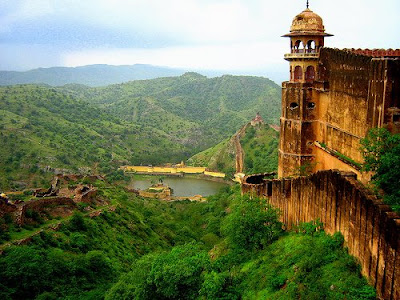
Jaigarh fort

Chiefly constructed for defense purposes, the Jaigarh Fort is a huge moated castle containing all the gadgets of a full-fledged citadel. One of the exigent charms of this majestic fort is the world's largest cannon on wheels, the Jaivan. It has a 20-foot-long barrel, its wheels are 9 feet in diameter and it took 100 kg of gunpowder to fire a single shot. Parables say that the cannon was used only once and the shell fell some 35 km away on a village! But that's quite dubious, since a deeper scrutiny of the cannon actually debunked that it had been fired at least a couple of times.
Jaigarh Fort
The historical Jaigarh fort palace in Jaipur also has a magnificent water channel management system for harvesting rain water. One of those reservoirs measures 158 feet by 138 feet and is 40 feet deep, and can hold 60,00,000 gallons of water; an artificial oasis made to satiate the thirst for water and eternal glory simultaneously.
Because it is considered as one of the most well fortified structures in India, because this fort was never being captured, because it has myriads of motifs and bastions, you get a real feeling of its glorified days. The armory displays numerous majestic swords, adamant shields, unforgivable guns, impenetrable muskets and even a 50 kg cannon ball; think about the strength the robust maharajahs used to have! The Museum in the fort presents a large array of photographs of the Maharajahs, royalty, buildings and processions and even a circular pack of cards besides many other antiques of the past.
Reblog this post [with Zemanta]

Tuesday, June 2, 2009

Mehrangarh fort – The rich heritage of India

Nestling within the depths of the Thar, the imperial city of Jodhpur echoes with tales of antiquity in the nihility of the desert. Flanked on the western side by the Mehrangarh Fort and on the eastern side by the stately sandstone palace of Umaid Bhawan, its monuments, temples and gardens depict a multi-faceted grandeur. But the gravity that pulls everyone to Jodhpur, is its vicinity to a desert landscape, almost as barren as the moon. This makes the medieval fort seem more magical, a larger than life version of an idealized illustration in a child's book. The Mehrangarh Fort, which looks as if it grew organically out of the low hill on which it is built, surely puts everything else in the city, completely in shade.

Mahrangarh fort

Den of The Chivalrous Rajputs

Before you buy your ticket and enter the fort, walk to the edge of the parking lot for the first of the many panoramic vistas it affords. The view one gets from this spot probably does not have a parallel anywhere in the world, as it is one of the largest fort structure in the world. It is as if the entire Old City, with its alleyways, courtyards and terraces, lies open to your gaze, as in one of those miniature paintings of cityscapes. It is not just what you see that gives the view its intimacy, but the way it blends with the sounds rising up from the houses and streets. It is fun to hear individual voices from the vantage point and trace down where they come from.

You have to bestow an entry fee to pierce the grim, once nearly impenetrable walls, which conceal magnificent palaces spanning five centuries of Rajput glory. Get an entrance ticket from the main portico at Jaipol, built by Maharajah Man Singh. Don't forget to climb the summit (Lohapol) through the steep zigzag ascent, where there are hand prints of Raja Mansingh's widows, who committed "Sati" (traditional Hindu practice of a widow immolating herself on her husband's funeral pyre happily, no longer a custom) rather than suffer at enemy's hands. The images of the hands of Hindu widows of the Rajput reverberates the devotion of these women and the high status of the men for whom the women committed Sati.

Inside the fort, behind the lotus-patterned, lacework sandstone facade, are many places to be explored. In order to create the original fort, legend has it that, a hermit was evicted from his abode. During the eviction he lay a curse upon any future building on the hill. He stated that any building on the hill would have severe problems annexing water. To avoid the consequences of this curse, a man volunteered to be buried alive in the foundations of the fort.


Reblog this post [with Zemanta]

Friday, May 8, 2009

The language of India

Language
India is a multilingual country. It has been said that India is a living Tower of Babel! There are fifteen national languages recognized by the Indian constitution and these are spoken in over 1600 dialects. Add to this a population of over 900 million today, and the remark would seem to be true.

India's official language is Hindi in the Devnagri script. However, English continues to be the official working language. For many educated Indian people, English is virtually their first language, and for a great number of Indian people who are multi-lingual, it will probably be the second.

Some Indian languages have evolved from the Indo-European group of languages. This set is known as the Indic group of languages. The other set of languages are Dravidian and are native to South India, though a distinct influence of Sanskrit and Hindi is evident in these languages. Most of the Indian languages have their own script and are spoken in the respective states along with English.

The country has a wide variety of local languages and in many cases the State boundaries have been drawn on linguistic lines. Besides Hindi and English, the other popular languages are Assamese, Bengali, Gujarati, Kannada, Kashmiri, Konkani, Sanskrit, Sindhi, Tamil, Malayalam, Marathi, Punjabi, Oriya, Telugu and Urdu.
Reblog this post [with Zemanta]